Insights
Table Of Content
What Is an Offshore Development Center? (Direct Definition)
How Does an Offshore Development Center Actually Work?
Offshore Development Center vs. Outsourcing vs. Staff Augmentation
Which Industries Use the ODC Model Most?
When Does an ODC Make Sense for Your Company?
What Does an Offshore Development Center Cost in 2026?
How Long Does It Take to Set Up an Offshore Development Center?
ODC Trends to Watch in 2026
Why Vietnam Is a Strong ODC Destination
Risks of the ODC Model and How to Mitigate Them
How to Choose the Right Offshore Development Center Partner
How to Choose an Offshore Development Center Partner
The S3Corp Approach to Offshore Development Centers
Next Steps
Frequently Asked Questions
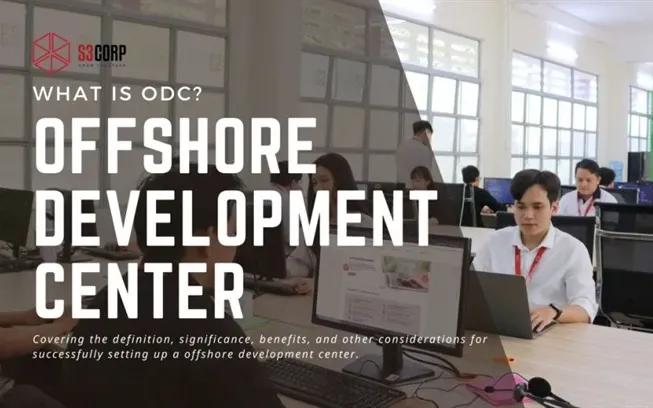
A dedicated offshore engineering team explained for CTOs and VPs of Engineering: what an ODC is, what it costs in 2026, how setup works, and how to decide if it fits your product roadmap — based on 19 years running teams in Vietnam.
06 Sep 2023
Every engineering leader eventually hits the same wall: the roadmap is bigger than the headcount budget allows, and the local market cannot fill the gap fast enough. An offshore development center, or ODC, is one answer to that problem, and it is one of the most misunderstood terms in software delivery. Some people picture a call center with a different name. Others assume it is just outsourcing with a passport stamp. Neither is accurate.
An offshore development center is a dedicated engineering team, based in another country, that works exclusively for your company and functions as a direct extension of your in-house team. You set the priorities, run the sprints, and own the codebase. Your ODC partner — a company like S3Corp — handles recruitment, payroll, office infrastructure, and local compliance, so the operational load stays off your plate while the technical decisions stay in your hands.
This guide breaks down how the model actually works, what it costs in 2026, how it compares to traditional outsourcing, and how to decide whether it fits the stage your company is at.
An offshore development center is a dedicated software team, located in a different country, that operates under your direction while a local partner manages employment and infrastructure on your behalf. It is not a project you hand off and collect later. It is a team you run.
The distinction matters more than it sounds. With an ODC, developers report to your product managers, join your sprint ceremonies, and build institutional knowledge of your codebase over years, not weeks. The partner's job is to stay in the background: sourcing candidates, running payroll, and keeping the lights on, while you keep making the calls on architecture, priorities, and quality bar.
Here's a way to think about it that tends to land with executives who have never run an offshore team before. Traditional outsourcing is like booking a hotel room: someone else decides the layout, the furniture, and the rules, and you simply check in and check out when the work is done. An ODC is closer to leasing an apartment. You choose who lives there, you set the house rules, and the space stays yours for as long as you need it. The provider still handles the lease paperwork and the building maintenance — you just are not doing the landlord's job on top of your own.
Quick facts table
|
Metric |
Typical 2026 Range |
|
Setup time (contract to full productivity) |
8–14 weeks |
|
Minimum practical team size |
3–5 developers |
|
Typical contract length |
12+ months |
|
Vietnam senior developer cost (fully loaded) |
$2,300–$4,000/month |
An ODC splits the work into two clear lanes: you own the "what" and "why," and your partner owns the "who's on payroll" and "where do they sit." That division is what lets you scale a team abroad without opening a foreign legal entity.
On your side, you define the roles you need, run technical interviews, and make the final hiring call on every candidate. You set daily priorities, own the codebase and architecture decisions, and fold the offshore team into your existing tools and rituals — the same standups, the same Jira board, the same Slack channels your local engineers use. Product vision stays with you, the same way it would with an employee down the hall.
Your partner's job runs underneath that. They source candidates against your specification, handle contracts, payroll, and tax withholding, and provide the workspace, equipment, and connectivity. They manage HR administration — leave tracking, performance documentation, statutory compliance — and if someone resigns, they run the backfill search at no extra charge to you.
|
Responsibility |
Owned by You |
Owned by the Partner |
|
Technical decisions, architecture, code ownership |
You |
|
|
Daily priorities, sprint planning |
You |
|
|
Payroll, tax withholding, benefits |
|
Partner |
|
Recruitment sourcing, workspace, equipment |
|
Partner |
The result, when it works well, is a team that behaves like an internal department rather than a vendor. That is the entire value proposition of the model — and it is also why picking the wrong collaboration structure at the start can undercut it. If you are still weighing which engagement model fits your situation, the breakdown in Collaboration Models at S3Corp walks through the practical differences before you commit to one.
The short answer: an ODC builds you a dedicated long-term team, traditional outsourcing delivers a defined project, and staff augmentation slots individual contractors into a team you already run. Each model solves a different problem, and picking the wrong one is the most common reason offshore engagements underperform.
Traditional outsourcing works by outcome. You define a scope, agree a price, and the vendor decides how the work gets done internally, often assigning developers across several clients at once. It is efficient for a fixed, well-specified deliverable — a marketing site, a one-off integration, a defined MVP — but it is a poor fit for a product that needs continuous iteration, because the team disbands (or moves to another client) once the contract ends.
Staff augmentation fills a narrower gap: one or two specialists dropped into a team you already manage day-to-day, usually to cover a skills gap or a temporary spike in workload. It is fast and flexible, but it does not give you the deep, compounding product knowledge that a dedicated team builds over years.
An ODC sits between those two, structurally closer to a second in-house department than to either. You are not buying a deliverable and you are not renting a headcount for three months. You are building a team that stays with your product long enough to know why a workaround exists in the payment flow or which architecture decision to revisit before you scale.
|
Model |
How It's Structured |
Best Fit For |
|
Offshore Development Center |
Dedicated team, your control, 12+ month horizon |
Ongoing product development, long-term scaling |
|
Traditional Outsourcing |
Vendor-managed, project scope and price |
One-off projects with a clear endpoint |
|
Staff Augmentation |
Individual contractors inside your team |
Short-term skill gaps, workload spikes |
For a deeper comparison of where the model boundaries actually fall in practice, Pros and Cons of Offshore Software Development lays out the tradeoffs on both sides. And if geography — not just structure — is the open question for you, Nearshore vs. Offshore Software Development covers how time zone proximity changes the calculus.
Product companies with continuous, security-sensitive, or highly technical roadmaps tend to get the most out of the ODC model, because the value compounds with time — and regulated or fast-moving sectors cannot afford a team that starts from zero on every release. In practice, a handful of industries show up disproportionately in ODC engagements:
An ODC makes sense when your product needs sustained engineering capacity, not a one-time delivery — the model earns its setup cost through years of accumulated context, so it underperforms if you only need three months of work. A few situations consistently justify the investment.
Long-term product development. If your roadmap spans years rather than a single release, an ODC amortizes its setup cost across a long runway of feature work, performance tuning, and security patching. You avoid the stop-start pattern of hiring contractors for every new initiative.
Skill shortages at home. Finding a senior machine learning engineer or a DevOps specialist can take months in the US, UK, or Australia, and salary expectations often outpace what a growing company can sustain. An offshore market with a deeper bench in that specialty solves the supply problem directly rather than forcing you to compromise on the hire.
Digital transformation initiatives. Enterprises modernizing legacy platforms or migrating to the cloud typically need a surge of capacity for twelve to eighteen months. Hiring fifteen local engineers for a temporary push creates a painful reduction-in-force conversation once the work is done; an ODC lets you scale down without that fallout. If legacy modernization is the trigger for your search, Legacy System Modernization at S3Corp covers the technical side of that specific challenge in more depth.
Budget predictability. Boards and CFOs favor stable, forecastable operating expenses over variable project invoices. A fixed monthly cost per developer slots cleanly into a financial model in a way that hourly billing never does.
Security-sensitive work. Financial services, healthcare, and other regulated sectors need direct control over who touches sensitive data. An ODC lets you enforce background checks, security training, and access audits the same way you would with local staff, because the team works exclusively on your systems.
If you are still uncertain whether your situation clears the bar, the honest tradeoffs are worth reading in full — Pros and Cons of Offshore Software Development does not oversell the model, which is exactly what a decision like this needs.
An ODC typically costs 40–70% less than hiring the equivalent role locally in the US, UK, or Australia, once you account for fully-loaded costs — salary, taxes, benefits, equipment, and office space — rather than base salary alone. The number that matters for budgeting is the all-in monthly rate per developer, not the sticker price of a single line item.
Why the gap is real, not just a headline. In the United States, the median annual salary for a software developer sits at $133,080, according to the Bureau of Labor Statistics' most recent occupational wage data. Once you layer on employer payroll taxes, health insurance, retirement matching, equipment, and office space, a fully-loaded US mid-level developer typically costs $150,000–$190,000 a year. The equivalent hire through a Vietnam-based ODC lands in the $30,000–$50,000 range for the same seniority band, once you include the provider's margin and all statutory obligations. That is not a discount on quality — it reflects cost-of-living and exchange-rate differences, not a gap in output.
Vietnam cost bands by seniority (fully loaded, monthly):
|
Seniority Level |
Monthly Range (USD) |
|
Junior (1–3 years) |
$600–$1,300 |
|
Mid-level (3–5 years) |
$1,300–$2,500 |
|
Senior (5–8 years) |
$2,300–$4,000 |
|
Lead / Architect |
$2,500–$4,500+ |
These figures include gross salary, employer-side taxes, health insurance, equipment, workspace, and the provider's margin — there should not be hidden line items on top.
What moves the price. Niche skills command a premium. AI/ML engineering, blockchain development, and specialized framework expertise cost more than common stacks like React or Node.js, simply because the supply is thinner. Team size matters at scale too — providers commonly discount per-developer rates by 5–10% once a team crosses ten to fifteen people, and metro premiums apply: engineering talent in Ho Chi Minh City or Hanoi typically costs 10–20% more than talent in secondary cities.
A note on client-facing rates. Where the "monthly per-developer fee" model does not apply — for hourly or project-billed work — client-facing rates for Vietnam-based engineering typically run $26–$40 per hour, according to industry market analysis, with AI and machine learning specialization at the higher end of that band. That figure represents what the provider charges, not the individual developer's take-home pay, so it is not directly comparable to the monthly figures above.
For a company evaluating headcount plans against these numbers, Hiring Offshore Developers breaks the recruitment side of this cost structure down role by role.
A typical ODC takes 8 to 14 weeks from signed contract to a team running at full productivity, depending on role difficulty and team size. Specialized roles and larger teams push toward the longer end of that window; standard web development stacks move faster.
Budgeting for that ramp curve up front avoids the common mistake of expecting day-one output from a team that is still learning why your architecture looks the way it does.
The biggest shift in offshore engineering right now is not about geography — it is about why companies buy in the first place. Cost reduction, once the dominant reason to outsource, cited by roughly 70% of companies as their primary driver in 2020, has fallen to around 34% in 2026, according to recent KPMG benchmark research. Talent access and speed to market have taken its place as the leading motivators. That shift matters for how you should frame an ODC internally: pitching it purely as a cost play to your board undersells what the model actually delivers in 2026, which is capacity you cannot source locally at any price.
A few other patterns are worth building into your planning for the year ahead.
AI is changing the skill mix, not eliminating the team. Routine coding tasks are increasingly assisted by AI tools, and the Bureau of Labor Statistics still projects 15–17% job growth for software developers through the next decade — demand is shifting toward engineers who can build, deploy, and govern AI-assisted systems, not shrinking overall. An ODC partner who has already integrated AI-assisted workflows into daily development can get your team productive with those tools faster than a from-scratch local hire ramping up on the same tooling.
Security and infrastructure work is now the most-outsourced function, not the least. Industry survey data from Deloitte's outsourcing research shows cybersecurity and IT infrastructure have both become leading categories for outsourced work in 2026, a reversal from a few years ago when security was one of the functions companies were most reluctant to hand off. That shift reflects growing confidence in offshore security practices — but it also means the "how do you vet a partner's security posture" question from the previous section matters more this year than it did in 2022.
The senior talent gap is the real constraint, everywhere. Vietnam, like most fast-growing tech markets, is producing developers faster than it is producing deep senior expertise — the market currently has a thinner bench of eight-plus-year architects than India or Poland. The practical implication: if your project genuinely needs a principal-level architect on day one, plan the search timeline accordingly, or structure the team with a senior local lead paired with strong mid-level offshore engineers instead of expecting instant access to unlimited seniority.
None of these trends change the fundamentals of the model. They do change how a CTO should pitch it internally, staff it, and budget for it in 2026.
Vietnam has emerged as a leading offshore software development location by combining several factors that matter most to companies building dedicated development teams.
Vietnamese universities graduate 50,000+ IT professionals annually from programs emphasizing computer science fundamentals, algorithms, and software engineering principles. The local market absorbs only a fraction of this talent, leaving experienced developers seeking opportunities with international companies.
This supply-demand imbalance benefits foreign companies. You access talented developers who might earn $800-1,200 monthly working for local companies but can receive $2,000-4,000 monthly working on international projects. The opportunity cost drives motivation and retention.
Vietnam offers the cost efficiency of Asian markets while maintaining quality standards comparable to more expensive regions. Developers work with modern frameworks, follow industry best practices, and deliver production-quality code. The price-to-performance ratio often exceeds alternatives.
You pay significantly less than India or Eastern Europe while getting similar output. The difference comes from lower living costs and exchange rates rather than capability gaps.
Vietnam has maintained consistent economic growth, political stability, and foreign investment friendliness for two decades. The government views technology partnerships as strategic priorities, creating a business environment that supports long-term relationships.
Infrastructure continues improving with new office buildings, reliable internet connectivity, and expanding transportation networks. This stability reduces operational risk compared to markets with political uncertainty or frequent policy changes.
Younger Vietnamese developers learn English throughout their education and improve through international project work. While proficiency varies, most developers at mid-level and above communicate effectively in written and spoken English for technical discussions.
Cultural factors encourage continuous improvement. Developers understand that English capability expands career opportunities and actively work to develop communication skills.
Vietnamese developers value stable employment relationships and interesting technical challenges over job-hopping for marginal salary increases. Company loyalty remains stronger than in some markets where switching jobs every 12-18 months has become normalized.
This cultural tendency toward longer tenure reduces turnover costs, preserves institutional knowledge, and creates more effective long-term development model partnerships. Teams that start well often stay intact for 3-5 years or longer.
At S3Corp, this is the market that has been home base for 19 years of client partnerships — long enough to have made most of the mistakes once, so clients do not have to make them at all. If Vietnam is one of several locations on your shortlist, Best Offshore Software Development Countries compares it against the other major markets side by side.
The ODC model carries four recurring risks — communication gaps, time-zone friction, cultural indirectness, and remote-team isolation — and all four are manageable with process, not luck. None of them are reasons to avoid the model; they are reasons to plan for it deliberately.
Communication gaps. Text loses nuance, and developers sometimes hesitate to ask clarifying questions when English is a second language. The fix is structural: schedule regular video calls to build rapport beyond ticket comments, document decisions in writing, and create explicit space for people to admit confusion without it costing them anything socially.
Time-zone coordination. A 6–12 hour gap compresses your real-time collaboration window and can slow decisions that arrive outside overlapping hours. Establish a core overlap block — typically 2–4 hours daily — and lean on detailed written specs and recorded walkthroughs for everything that falls outside it. Accept that some decisions will take a day instead of an hour, and plan sprints accordingly.
Cultural communication style. Some cultures favor indirect communication to preserve harmony, which can mean a "yes" to an unrealistic deadline instead of the pushback you actually needed. Ask open-ended questions rather than yes/no ones, and reward the team members who flag problems early instead of the ones who stay quiet.
Team cohesion. Remote developers who are left out of company updates or decision-making start to disengage, and disengagement shows up in retention numbers before it shows up anywhere else. Include the offshore team in company-wide announcements, invite them to non-technical strategy conversations, and arrange occasional in-person visits where the budget allows.
Documentation and quality consistency. Without a shared codebase standard, a distributed team can drift into inconsistent commenting, testing, and review habits, especially once the team grows past a handful of people. Set the bar early: agree on code review requirements, testing coverage expectations, and documentation standards before the first sprint, not after the first incident. A partner with a mature internal quality process will already have a version of this in place and will adapt it to your standards rather than starting from a blank page.
None of these risks are unique to Vietnam or to S3Corp — they are structural to distributed teams anywhere. Offshore Software Development: How to Collaborate Well goes deeper into the specific rituals and tooling that keep a distributed team functioning like one team instead of two.
The right ODC partner is the one that is transparent about tradeoffs, has a proven retention record, and has demonstrated technical depth in your specific stack — not the one with the lowest quoted rate. Price is the easiest variable to compare and the least predictive of a successful engagement.
If recruitment quality is your biggest open question, Hiring Offshore Developers walks through what a rigorous vetting process should actually look like from the outside.
Selecting the right provider determines whether your offshore IT team becomes a competitive advantage or an administrative headache.
Verify the provider has proven experience with your specific technology requirements. Ask for case studies using similar frameworks, languages, and architectures. Interview their technical leadership to assess depth of expertise, not just surface familiarity.
Check whether they stay current with technology trends or rely on outdated practices. Look for investment in training programs, conference participation, and internal knowledge sharing.
Quality providers explain their business model clearly, including how they price services, how they source candidates, what their margin structure looks like, and how they handle common challenges like team member resignations or performance issues.
Avoid providers who make unrealistic promises or deflect questions about difficulties. Real operations always involve tradeoffs. Partners who acknowledge complexity inspire more confidence than those who claim everything is perfect.
Evaluate how the provider communicates during the sales process. Do they respond promptly to questions? Do they provide clear explanations without jargon? Do they listen to your needs before proposing solutions?
Sales communication quality typically predicts operational communication quality. If coordination feels difficult before you sign a contract, it will not improve afterward.
Ask for annual turnover statistics over the past 3-5 years. Strong providers maintain 80-90% annual retention through competitive compensation, career development programs, interesting project work, and positive work environments.
High turnover creates continuous disruption, knowledge loss, and recruiting costs. Retention matters more than initial recruitment speed.
Review their information security policies, access control procedures, and compliance certifications. ISO 27001 certification indicates mature security practices. SOC 2 compliance demonstrates audited controls around data protection.
Understand how they handle intellectual property, what employment contracts specify about code ownership, and what happens to your assets if the relationship ends.
At S3Corp, an ODC engagement starts from a simple premise: the team should feel like a department you already run, not a vendor relationship you have to manage. Clients across North America, Europe, and Asia-Pacific work with dedicated teams built around modern stacks — React, Angular, Vue.js, Node.js, Golang, Python, Java, .NET, iOS, Android, React Native, and Flutter — spanning full application delivery from Application Development at S3Corp, ongoing release and infrastructure work through DevOps Services at S3Corp, and quality gates handled through Quality Assurance at S3Corp. The full service catalog is outlined at Services at S3Corp.
Nineteen years of operating in Vietnam has produced a straightforward operating style: transparent pricing, developers who stay long enough to know your product, and honest guidance about what an ODC will and will not solve for a given team. Optimizing cost and performance is the starting point of every engagement, not the whole pitch — the goal is a team that contributes ideas about scalable architecture and product direction, not just a headcount line that executes tickets.
For a broader look at how offshore engineering fits into a company's overall delivery strategy, Software Outsourcing Services and the Ultimate Guideline covers the landscape beyond the ODC model specifically.
An ODC is not the right call for every company, and the honest version of this guide should say so plainly: if your need is a single, well-defined project with a clear end date, traditional outsourcing will likely serve you better and cost less to set up. If your roadmap runs for years and you need a team that gets smarter about your product every quarter, the ODC model is built for exactly that.
If you are trying to size a team, estimate a realistic budget, or just want a second opinion on whether this model fits your stage, reach out through Contact S3Corp and a member of the team will walk through your specific roadmap and constraints — no pressure, no generic sales deck.
An offshore development center is a dedicated software team based in another country that works exclusively on your projects while a local partner handles employment, infrastructure, and administrative compliance. You retain full control over technical decisions, daily priorities, and team direction, the same as you would with in-house staff.
Costs depend on location, seniority, and specialization. In Vietnam, fully-loaded monthly rates in 2026 typically run $600–$1,300 for junior developers, $1,300–$2,500 for mid-level, and $2,300–$4,500+ for senior and lead roles, including salary, taxes, benefits, equipment, and provider fees.
It depends on the shape of the work. An ODC fits long-term product development where you need dedicated capacity and accumulated domain knowledge. Traditional outsourcing fits defined projects with a clear scope and endpoint. Choose based on your timeline, not on price alone.
Most ODCs go from signed contract to full productivity in 8 to 14 weeks. Requirements definition and provider selection typically take three to four weeks combined, recruitment spans three to six weeks, and onboarding adds another four to six weeks before the team reaches full output.
Most companies start with three to five developers to validate the model and establish working processes, then scale to ten to twenty people over twelve to twenty-four months as trust builds. Teams smaller than three people often struggle with coverage during absences and knowledge sharing.
ODC stands for Offshore Development Center. In software and IT contexts specifically, it refers to a dedicated engineering team based in another country that operates as an extension of a company's in-house staff. The same acronym is used in unrelated industries — hotels, construction, and finance each have their own meaning for "ODC" — so context always determines which definition applies.
Vietnam combines a large and growing developer pool — roughly 530,000 to 600,000 working developers — with independent rankings like 7th globally on the Kearney Global Services Location Index, competitive costs relative to India and Eastern Europe, and a cultural tendency toward longer job tenure that supports team continuity.

Whether you have any questions, or wish to get a quote for your project, or require further information about what we can offer you, please do not hesitate to contact us.
Contact us Need a reliable software development partner?
S3Corp. offers comprehensive software development outsourcing services ranging from software development to software verification and maintenance for a wide variety of industries and technologies





Software Development Center
_1746790956049.webp&w=384&q=75)
_1746790970871.webp&w=384&q=75)